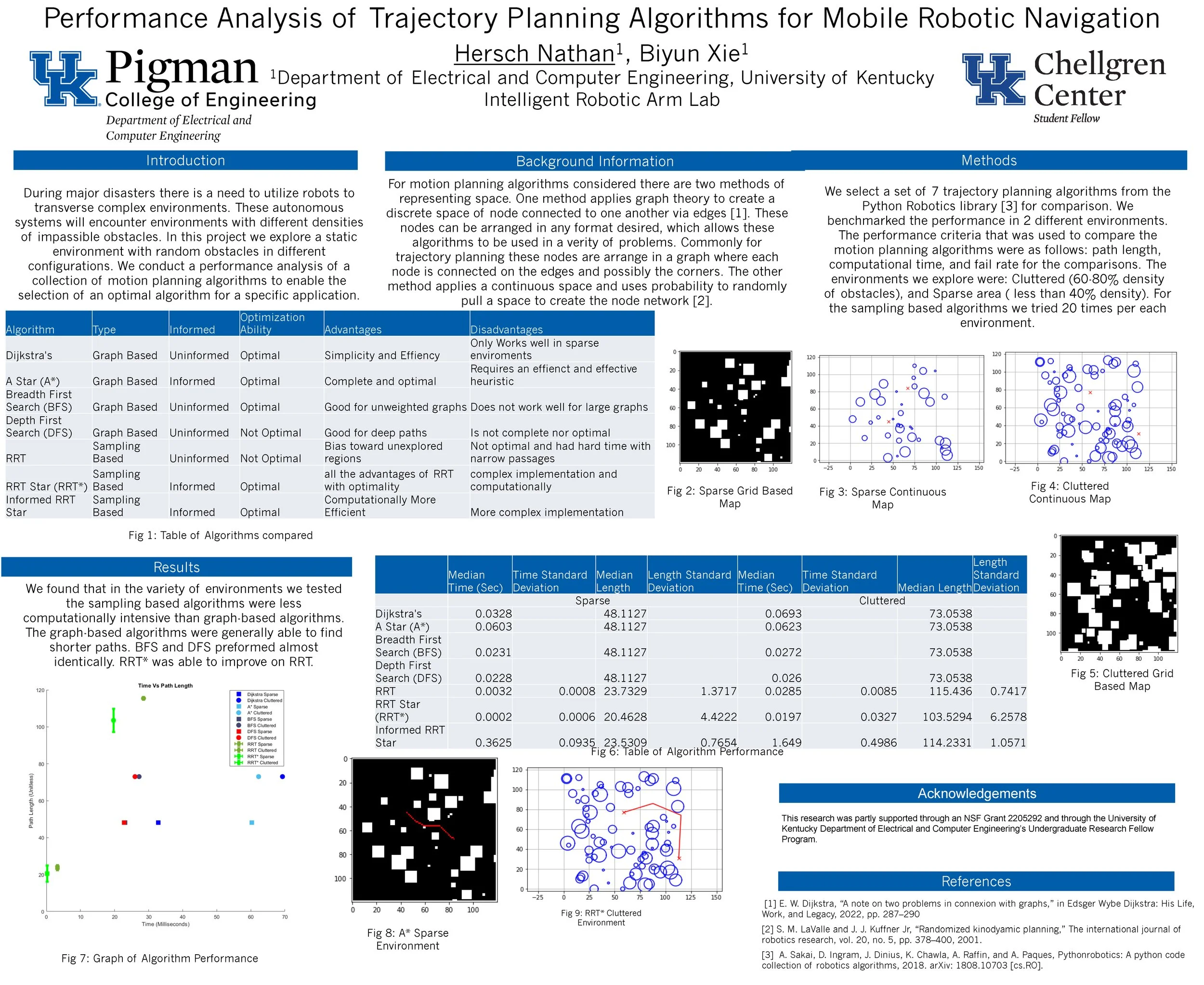
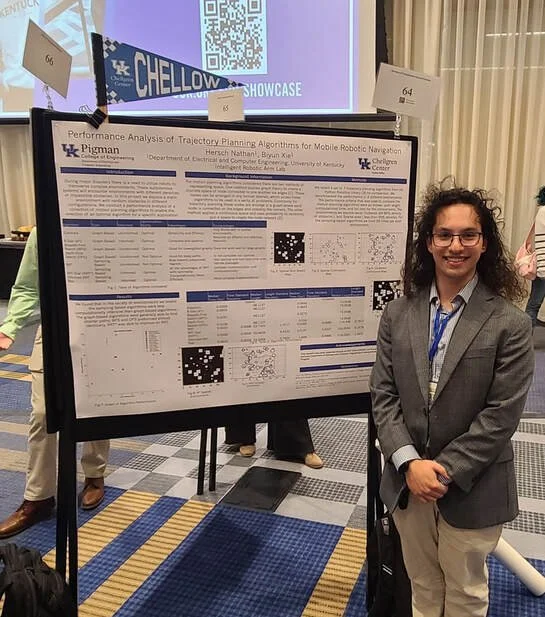
Performance Analysis of Trajectory Planning Algorithms for Mobile Robotic Navigation
Presented at the University of Kentucky's Department of Electrical and Computer Engineering Spring Research Symposium and at University of Kentucky Office of Undergraduate Research 18th Showcase of Undergraduate Scholars
Abstract:
When major disasters happen, there is a need for robots to traverse complex environments. Those environments have many different components from impassible obstacles to density of obstacles, and even dynamics. The traditional approach to solving this problem is using trajectory planning algorithms. Broadly speaking, there are two approaches; graph based and sampling-based algorithms. Graph based algorithms are of the family of Dijkstra's which traditionally finds the shortest path between nodes in a weighted graph in discrete space. Sampling-based algorithms find the shortest path through a weighted random pulling of in a continuous space.
In this project we explore a static environment full of obstacles in different configurations. We conduct a performance analysis of a collection of trajectory planning algorithms. The configurations we are interested in are ones with transitional areas of different density. Primarily we are looking at the path length, computational time, and fail rate.
This research was partly supported through an NSF Grant 2205292 and through the University of Kentucky Department of Electrical and Computer Engineering’s Undergraduate Research Fellow Program.